
SciArt Exchange Design Your Habitat Contest
SciArt Exchange and Queens Public Library invite teens to imagine the future of human life beyond Earth.
In the Design Your Habitat STEAM Challenge, students will explore what it takes to live on the Moon, Mars, or in space—and artistically design their own futuristic habitat.
Teens will learn about real challenges astronauts face, like radiation, microgravity, and sustainability, and then create an artistic vision for a thriving space community.
Round One: Summer 2026
See the entries below. Click on each image to see the full pictures or watch the video.
Round Two: Fall 2026
Coming Soon!
Best in 3D Art
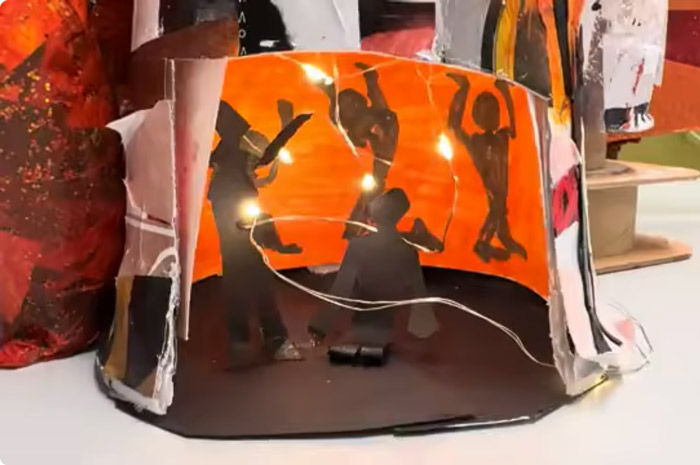
Unattainable, But Not Out of Reach
Ming Q, Flushing Library
In a world where the ultra wealthy exist, the common people will be left behind. The people have been left behind on a world that has become uninhabitable; the Earth is burning. Flames in the shape of hands sprout out from the ground to oppress the masses. The hands hold them down to the planet, preventing their escape. People climb atop buildings to save themselves but ultimately they are crushed by the flames. In a way, the fire is of their own making, they allowed the flames to grow and fester. Every bias and stereotype fed the division. When the people are divided they are distracted, allowing the ultra wealthy and powerful to gain an upper hand. As the world burns a select few escape, not because they are fundamentally different from the people burning, but because they are wealthy. They escape the planet they have set ablaze with their technology sitting comfortably in the ship as they watch the people burn. They feel no remorse, they do not care. The ship they sit in is a result of their exploitations, it is shaped like an alien spaceship, unnecessary and frivolous. The flames that shoot from the exhaust pipe set fire carelessly. It does not wait for us to catch up. A sci-fi world is not made for us. So we won't know what it looks like, we won’t ever inhabit it even if we neglect the fact that it’s far into the future. The End.
Best in Video with AI
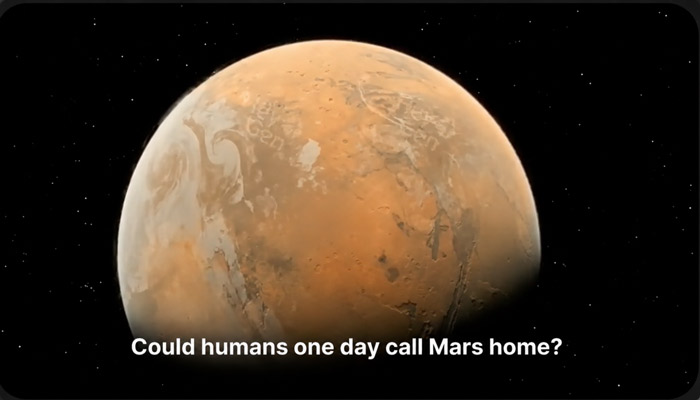
A Home on Mars: The Future of Human Survival
Kezia B, Central Library
I chose to generate a video with AI to be creative since I'm not good at art (drawing and painting), however I'm very interested in space science. I did research on inflatable habitats, Mars’ atmosphere and the soil where food can potentially be grown with. From the scientific facts I got from various websites including NASA I then went to AI to generate a prompt. With that prompt I then used an AI video generator, and it brought the prompt to life using a female British voice and background music. I wanted to showcase that scientific facts can be displayed in a fun, animated form and still be educational even if it's just a few seconds long. I hope anyone who sees this video learns something new or interested in the potential sustainable life humans may have on Mars.
Best in 2D Digital Art
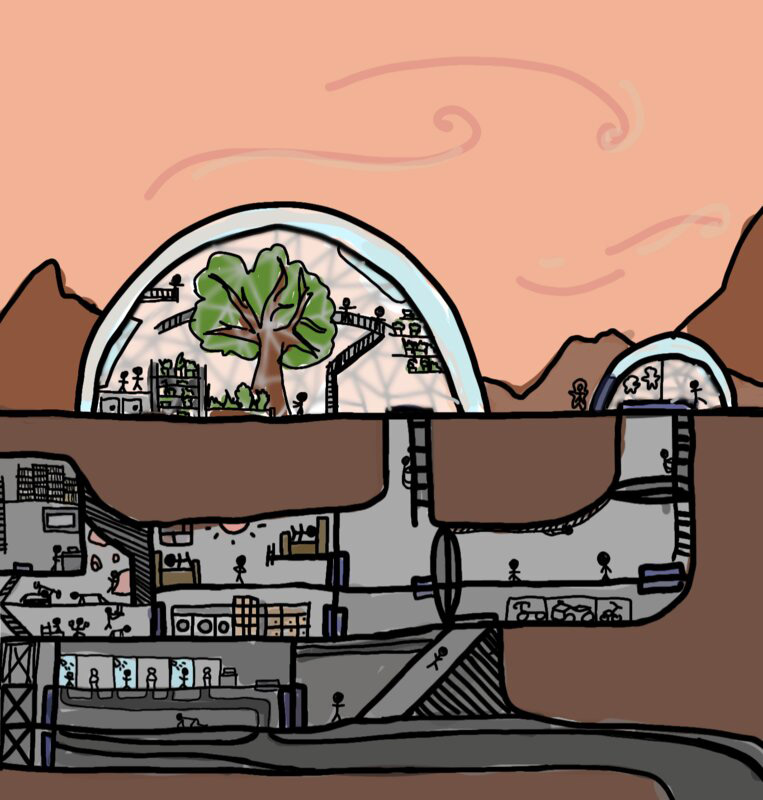
Under Mars
Cher L, East Flushing Library
Living and working on Mars.
Best in Team Art
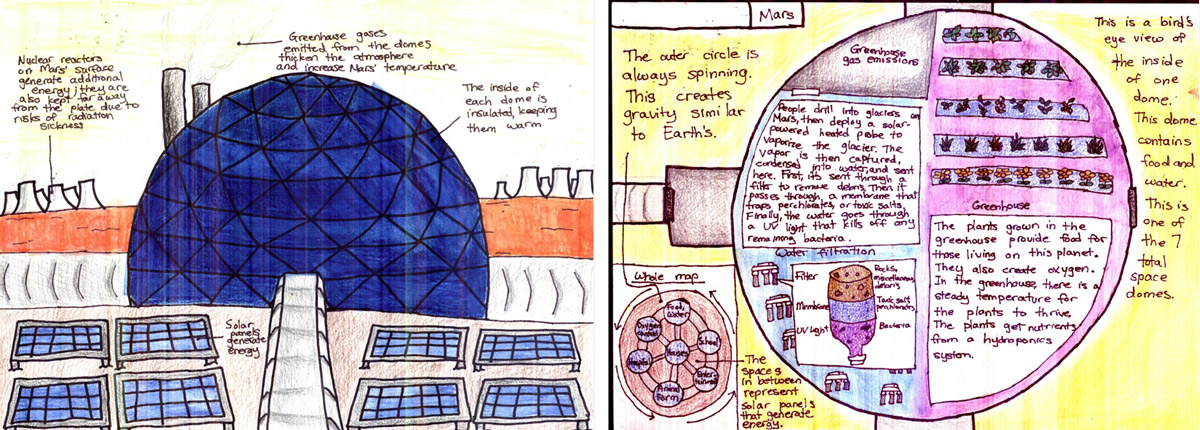
Domes on Mars
Kelandria A & Liliana A, East Flushing Library
Imagining and researching what life on Mars would be like.
Best in Hand Drawn 2D Art
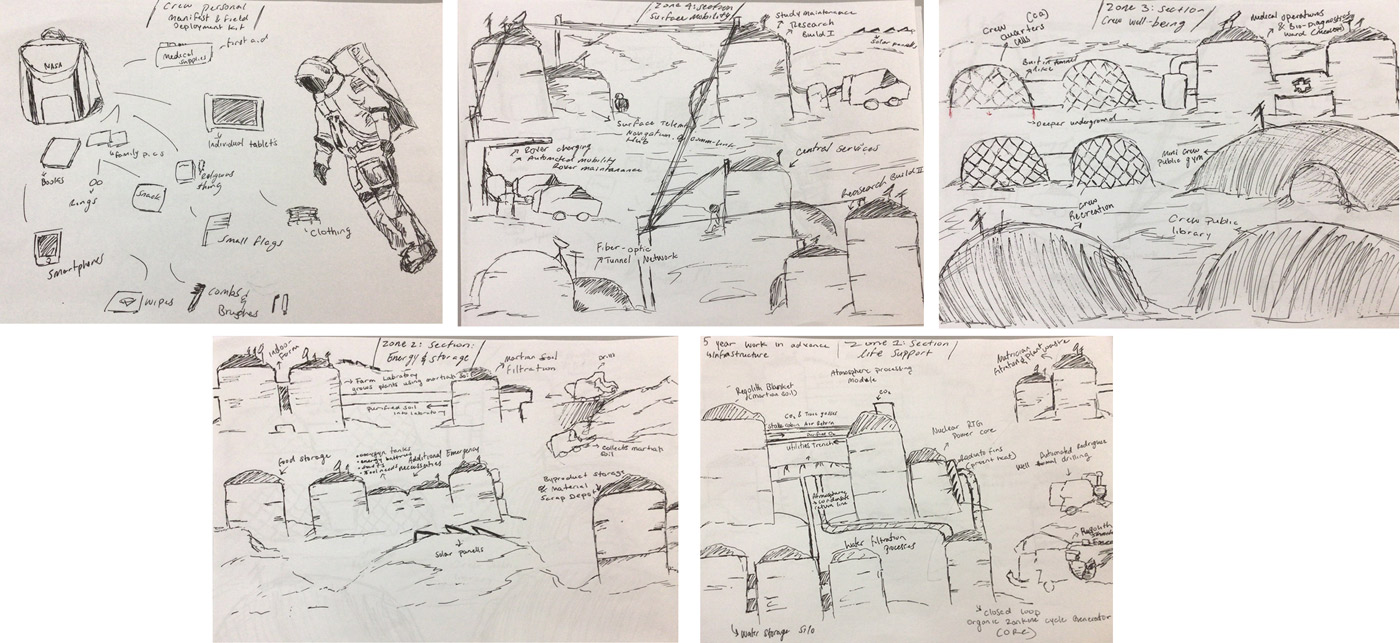
Mars Surface Habitat: Integrated Life Support, Mobility, & Human Factors Schema (A Pre-staged, Radiation-shielded Ecosystem for Long-term Planetary Survival)
Mona A, Central Library
My artwork visualizes a fully realized Martian habitat, translating complex engineering into a clear vision of human survival. By partitioning the structure into four strategic zones, i explore the necessary balance between industrial functionality, planetary surface logistics, and long-term psychological endurance. Zone 1 establishes the core life-support infrastructure. Protected under a thick regolith radiation blanket, this area utilizes closed-loop atmospheric recycling, moisture reclamation, and subsurface thermal drilling alongside a nuclear-driven auxiliary electrical grid. Zone 2 manages resource redundancy and soil filtration, purifying raw ground to feed a farm laboratory while highlighting survival contingencies through solar arrays, subsurface batteries, and a manufacturing scrap depot. Zone 3 centers heavily on human sustainability and medical resilience. Deep underground, geodesic crew cells connect via subterranean transit to bypass harsh surface travel, addressing well-being through medical wards, a low-gravity resistance gym, and cognitive relief spaces. Zone 4 acts as the logistical hub for external exploration and communication, featuring a surface telemetry hub and a dust-shielded maintenance hangar linked via a subsurface fiber-optic network. Ultimately, this project serves as a blueprint, examining the thin line separating human fragility from technological resilience.
The Hive
Gabriela V, Flushing Library
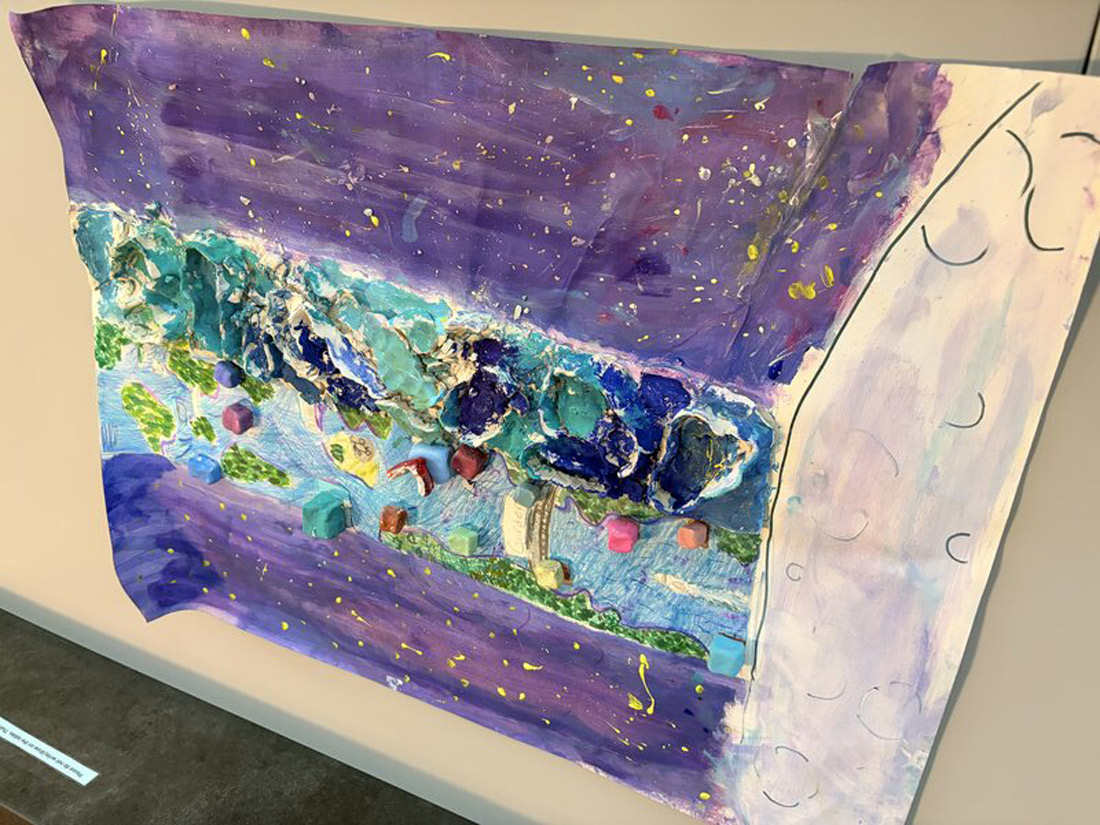
This is the project I made called “The Hive.” I used markers, color pencils, and clay. This is a painting that is divided in half. One half is how it would look like in bird view, the other is how it would look like outside. The inside is how humans would live inside the tower. The colorful cubes are towns. Each town will have a small community garden. The big cube with the red book atop is a city. What’s special about this city? It has a library with 3D Earth pictures and museum collections from Earth. So the past can always be remembered. The biggest green cube is another city, this time it has a lab and schools to teach science. If a person wants to be a scientist, they will go here. The big green part with a bridge is a garden. People who need groceries would go here and buy it for a low price. The garden will also be used for experiments as you can see in my drawing/map, everything is surrounded by water. The water will be used for bathing, gardening, and cooking. The water will be cycled and purified. Titanium bottles will be sent to Mars to collect H2O. To have gravity there, the lower part will spin fast that’s how artificial rockets have artificial gravity. It will also be protected by space rocks and sun rays, resources round will be used like moon rocks. All resources will be recycled- an old shirt can be recycled or reused for cloth. These items will go through a science lab to be inspected for recycling. Food scraps will be used for compost. This is my idea of how people will live on the moon.
The Egg Habitat
Lucas Z, East Flushing Library
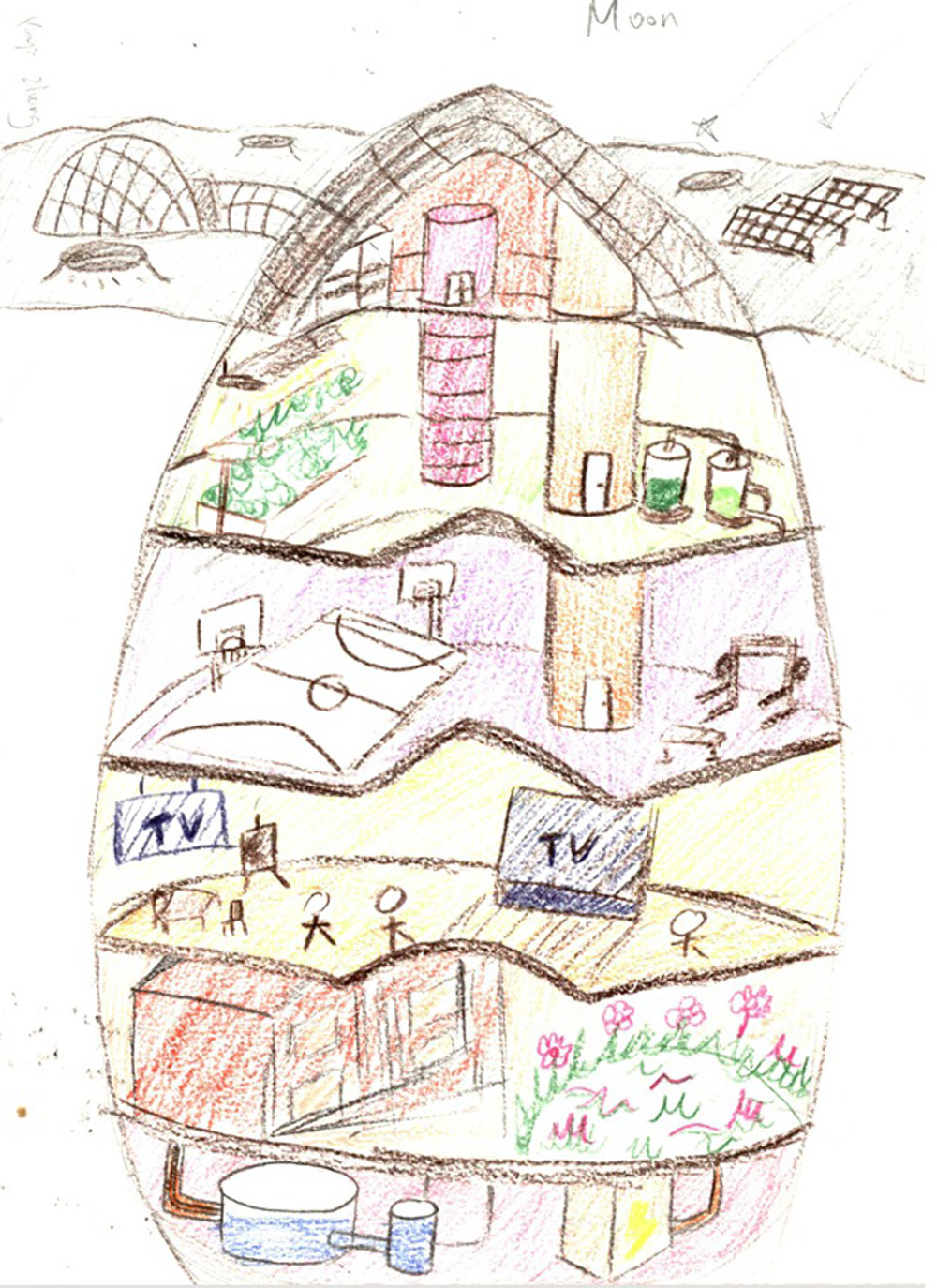
Lunar Egg-shaped habitat with all kinds of entertainment for humans in space.
Necessities of Space Life
Annie W, Flushing Library
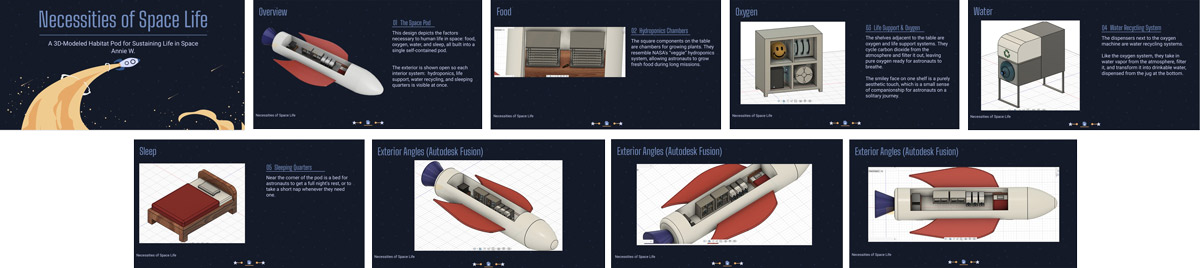
The design I made In Fusion depicts factors necessary to human life: food, oxygen, sleep and water. The square components on the table are chambers for growing plants. They resemble the hydroponics design made by NASA called ‘veggie’. The shelves adjacent to the table are oxygen and life support systems, they cycle the carbon dioxide in the atmosphere and filter out the carbon molecules, leaving pure oxygen ready to be used by astronauts! The smiley face on one of the shelves is merely for aesthetic purposes, giving astronauts boarding the spaceship a sense of companionship on this solitude journey in space. The dispensers next to the oxygen machine are water recycling systems. Similar to the oxygen system, it takes in water vapor in the atmosphere, filters it, and transforms it into drinkable water that dispenses out of the water jug at the bottom. Lastly, nearing the corner is a bed for astronauts to get a night’s worth of sleep, or to take a short nap in, whatever they feel like.
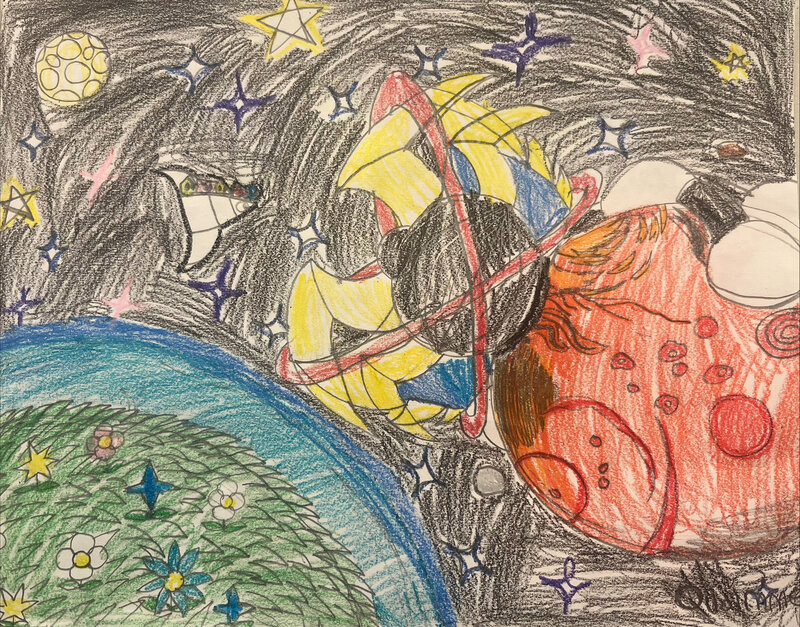
Party Planet
Quaimme F, Cambria Heights Library
Quaimme used pencils and crayons to complete his original work. Party Planet is a stationary ship that floats between Earth and Mars.
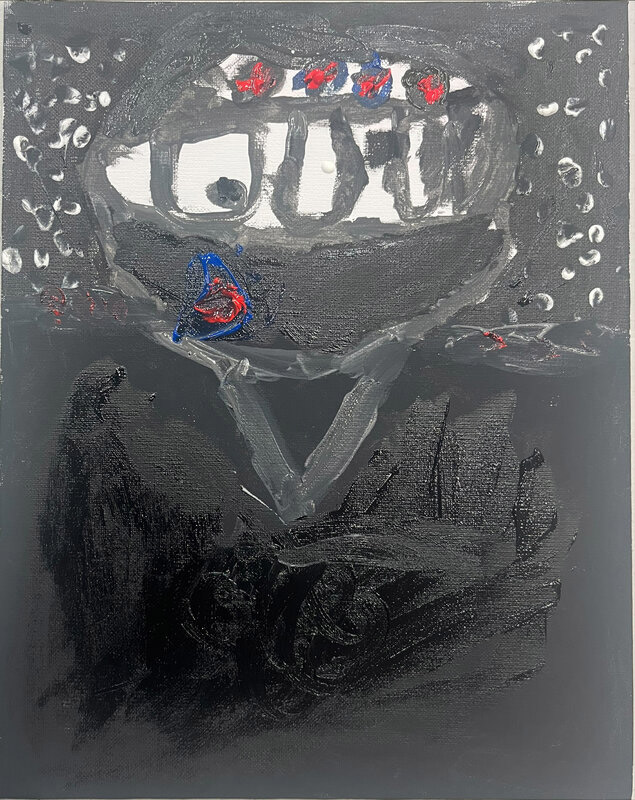
Eli's Space Shuttle
Elijah O, Cambria Heights Library
Elijah used images of spherical shaped space stations and shuttles to create his painting.
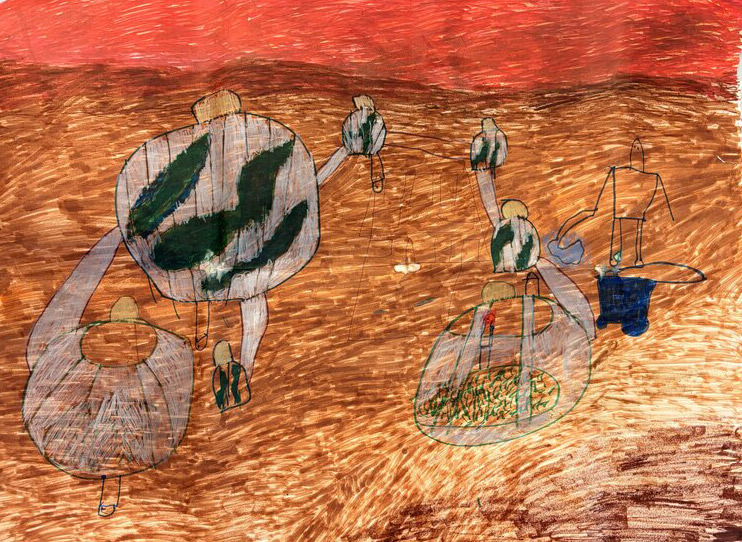
How Humans Could Live on Mars
Tiffany G, Flushing Libraryy
Mars was made 4.5 billion years ago and to the Romans it was a symbol of war and blood. Mars may seem like a waste land now but that waste land may hold the key to human survival. First I would like to say I took many ideas from movies to real life science. I studied how humans adapt to different places the Tibetans and Andean indigenous they live high in the trees they breathe faster. In my art you will see pods with greens inside them the pods are because if humans ever had to live on Mars they would need pods because air on Mars is not the best for human life, let alone the storms also the green is food. Humans would have to find a way to grow food. They would need fertilizer, the problem could be solved by using human waste now because human waste is full of bacteria and pathogens. It is not easy but if humans had some kind of fire they could heat it up to a high temperature it might work. Now the water problem. There is ice at the bottom of Mars so I made a robot. an ice robot. It would be a robot that could go out and get ice then put it in an ice melting machine which would melt the ice. Oh I also made tunnels so people can go from one pod to the next. On top of each pod is air pods in golden color and that is about it. Making this was really fun.
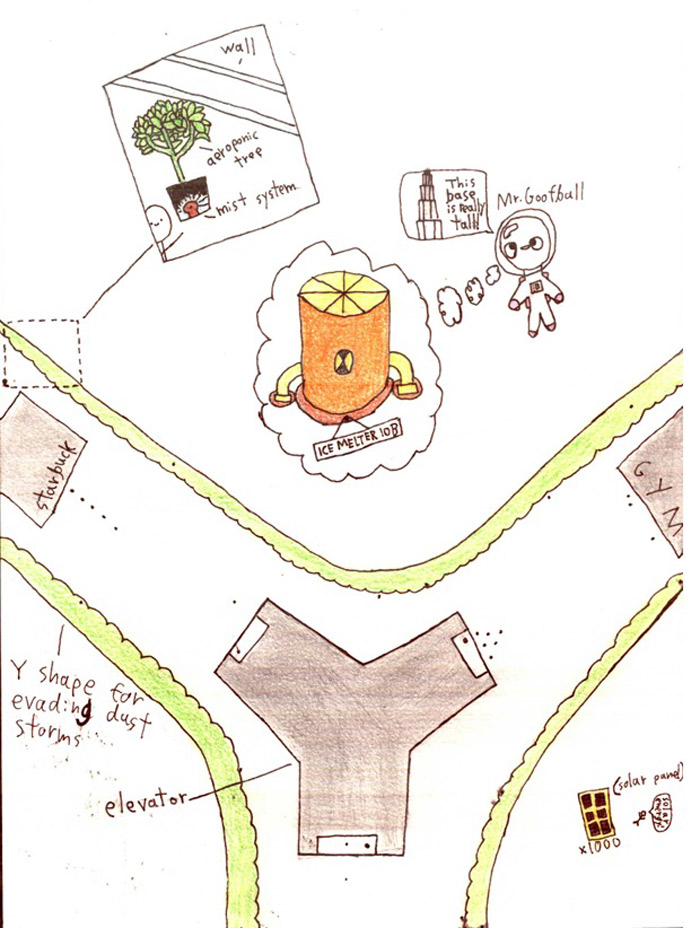
Trees of Air
Xuanyi L, East Flushing Library
Research.